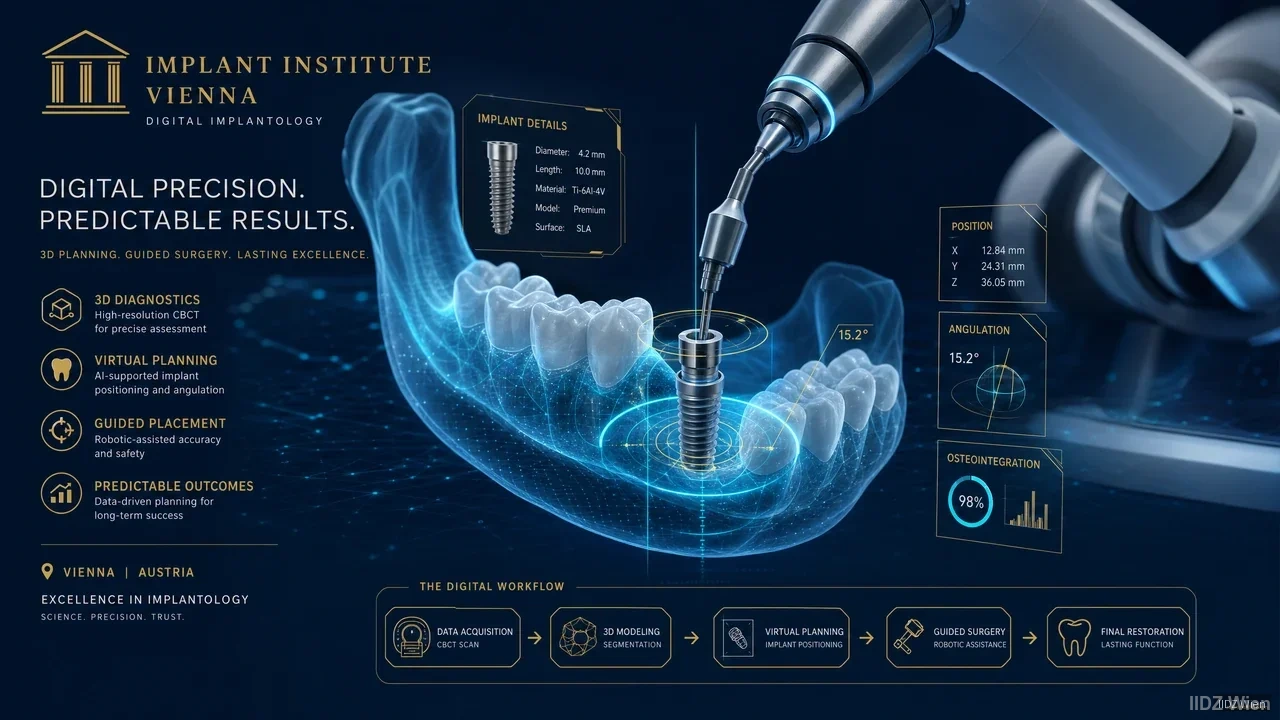
TL;DR: Navigated implantology reduces insertion deviation to below 0.5 mm. This is not marketing — these are reproducible measured values from clinical studies. For patients, this means: less risk, shorter procedures, better long-term results.
Why Precision in Implants Is Crucial
A dental implant is a surgical procedure with tight anatomical tolerances. The jawbone has limited width, nerve canals run in defined pathways, and neighboring teeth are in immediate proximity. A deviation of just 2 mm can become clinically relevant — either through injury to anatomical structures or through a prosthetically unfavorable implant position.
Traditional implantology uses drilling templates made from plaster models and two-dimensional X-ray images. Precision depends heavily on the surgeon's experience. Studies show deviations averaging 1.2–2.8 mm with conventional methods — a range that is clinically acceptable but not optimal.
The Digital Workflow: CBCT → Planning → Navigation
Digital implantology combines three technologies into one closed workflow:
What the Research Says
A systematic review by Tahmaseb et al. (2018, Journal of Dental Research) analyzed 9,000 implants from 20 studies. The result: fully guided surgery achieved a mean coronal deviation of 1.2 mm and an apical deviation of 1.4 mm — significantly better than conventional methods with 2.1 mm and 2.7 mm respectively.
Newer studies using dynamic navigation (real-time tracking) show even better results: coronal deviations below 0.8 mm are reproducibly achievable by experienced surgeons. The clinically relevant threshold is 2 mm — both methods are well below this.
What This Means for Patients
Higher precision has three direct consequences for patients:
- Shorter procedures: Less need for corrections during surgery means shorter anesthesia or sedation times.
- Fewer complications: Nerve injuries and bone perforation are significantly rarer with guided surgery.
- Better prosthetic results: Precise implant positioning simplifies later crown restoration and improves long-term stability.
When Is Navigated Implantology Beneficial?
Not every implant case requires the complete digital workflow. For simple single-tooth gaps with adequate bone supply and clear anatomy, conventional surgery remains a valid option. The added value of navigated methods is particularly evident in:
- Multiple implants (3 or more)
- Reduced bone supply or previous bone grafting
- Proximity to nerve canals (mandible) or maxillary sinus (maxilla)
- Immediate implantation after tooth extraction
- Full-mouth rehabilitation (All-on-4, All-on-6)
Quick Facts
IIDZ Wien — Wissenschaftliches Redaktionsteam
Facharzt für Orale Chirurgie, Wien
Weitere Artikel
Thematisch verwandt
Hinweis: Diese Inhalte dienen ausschließlich der allgemeinen Information und ersetzen keine individuelle zahnärztliche Beratung. Das Institut für Implantologie und digitale Zahnmedizin Wien ist eine gemeinnützige, unabhängige Wissenschaftsplattform — kein Behandlungsbetrieb. Alle Angaben entsprechen dem aktuellen Stand der wissenschaftlichen Literatur; individuelle Behandlungsentscheidungen müssen stets mit einem approbierten Zahnarzt oder Facharzt getroffen werden.