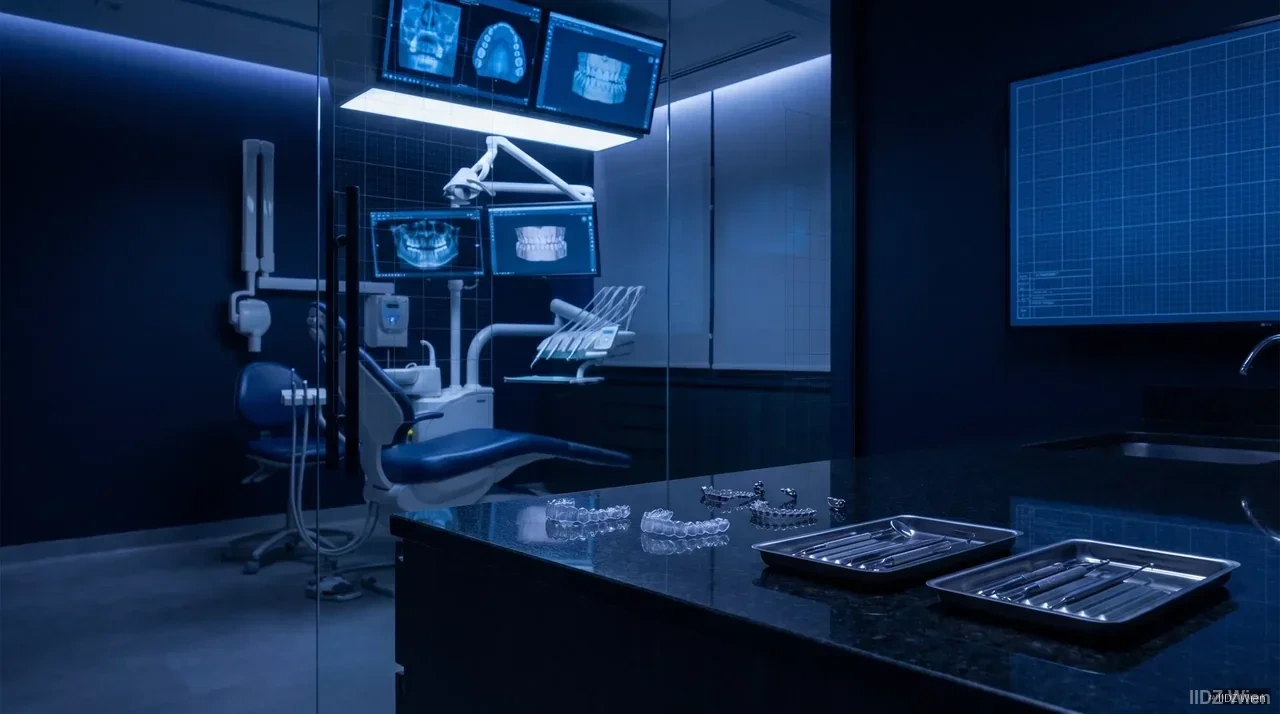
Intraoral scan instead of impression material
Intraoral scan instead of impression material
The intraoral scan captures tooth position in seconds — more precise than conventional impressions and without gag reflex. The digital data forms the foundation for all subsequent planning steps and can be transferred directly into planning software.
3D treatment planning and simulation
Specialized software calculates tooth movements and simulates the final result in 3D. The patient sees the planned result before treatment begins. The planning is documented, reproducible, and can be adjusted.
3D printing of aligner models
The aligners are manufactured based on digital planning — either through direct 3D printing of the aligners or by printing the models on which the aligners are thermoformed. The digital process chain makes fit precision reproducible.
CBCT for complex cases
In cases with skeletal involvement, crowding with bone deficit, or planned implant treatment after orthodontics, CBCT is necessary. CBCT shows root lengths, bone relations, and the location of anatomical structures — information that is crucial for treatment planning.

Vergleich
| Kriterium | Digital Workflow | Conventional |
|---|---|---|
| Diagnostics | Intraoral scan: precise, comfortable, immediately available | Impression material: gag reflex, deformation risk |
| Treatment planning | 3D simulation: result visible before treatment begins | 2D analysis: limited predictability |
| Aligner manufacture | 3D printing: fit precision reproducible | Manual models: variability in fit |
| Complex cases | CBCT: roots, bone, anatomy in 3D | 2D X-ray: overlays, limited information |
| Documentation | Fully digital, comparable, archivable | Plaster models, photos, variable |
Qualitätsstandards des Instituts
Intraoral scan as standard — no impression material in digital orthodontics
3D treatment simulation before treatment begins — result plannable and communicable
CBCT for skeletal involvement or planned implant treatment after orthodontics
Digital follow-up documentation: scan comparison at defined time points
Coordination with implant planning: orthodontic result as basis for implant position
Questions from Scientific Perspective
Clinical Implementation
Kieferorthopaedie bei Smile4Life
Der klinische Partner des Instituts, Smile4Life, führt die beschriebenen Behandlungen nach den Qualitätsstandards des Instituts durch.
Kurz erklärt
Digital Orthodontics uses 3D scans, AI-assisted treatment planning, and precisely fabricated aligners instead of impressions and wire brackets — for predictable results and greater comfort.
Wann ist das relevant?
- For tooth misalignments (crowding, gaps, crossbite)
- If you seek a discreet alternative to brackets
- In adults with aesthetic treatment requirements
- In combination cases with implants or prosthodontics
Passende Leitfäden
Fragen für das Erstgespräch
- Am I a suitable candidate for aligners?
- How long does treatment take and how many aligners will I need?
- How is the result digitally planned and can I see it in advance?
- inst-section-gray py-12 border-t border-[#DDE3EC]
Hinweis: Die Inhalte dieser Seite dienen ausschließlich der allgemeinen Information und ersetzen keine individuelle zahnärztliche Beratung durch einen approbierten Zahnarzt oder Facharzt. Das Institut für Implantologie und digitale Zahnmedizin Wien ist eine gemeinnützige, unabhängige Wissenschaftsplattform — kein Behandlungsbetrieb. Alle Angaben entsprechen dem aktuellen Stand der wissenschaftlichen Literatur; individuelle Behandlungsentscheidungen müssen stets mit einem approbierten Zahnarzt getroffen werden.