Dental implant – what you should know beforehand
Independent, evidence-based information for patients in Vienna and Austria: requirements, costs, procedure, risks, and the right questions for your initial consultation.
Contents of this guide

Who is a dental implant suitable for?
Single missing tooth
Most common application. Implant is the most proven long-term option, as neighboring teeth are not stressed.
Multiple missing teeth
Implants as bridge abutments or as basis for implant-supported dentures — without removable prosthesis.
Edentulous jaw
All-on-4 or All-on-6: Entire jaw on 4–6 implants. Fixed restoration, no palatal plate sensation.
Denture wearers with stability problems
2–4 implants can securely anchor a removable denture (implant bar denture).
Benefits of dental implants
Bone preservation
The only procedure that actively stimulates jawbone and prevents bone resorption after tooth loss.
No stress on adjacent teeth
Unlike bridges, healthy neighboring teeth are not ground down or stressed.
Long-term stability
95–98% survival rate after 10 years. With good care, lasts 20–30 years or longer.
Natural chewing sensation
Implants transfer chewing forces directly to bone — like natural teeth. No pressure spots.
Aesthetics
Zirconia crown is visually indistinguishable from natural teeth. No visible metal margins.
Hygiene capability
Implants are cleaned like natural teeth — no removal, no special cleaners required.
Medical requirements
Bone condition
- ✓Minimum width of jawbone: 6–8 mm
- ✓Minimum height: 10 mm (below maxillary sinus / nerve canal)
- ✓With bone loss: augmentation possible (sinus lift, bone grafting)
- ✓Assessment via CBCT (3D X-ray) — standard diagnostics
General health
- ✓No uncontrolled bleeding disorders
- ✓Diabetes: blood sugar well controlled (HbA1c < 7%)
- ✓No active periodontitis (pre-treatment mandatory)
- ✓No ongoing chemotherapy or radiation therapy in jawbone
Risk factors
- ⚠Smoking increases failure risk by 2–4 times
- ⚠Bisphosphonates (osteoporosis medications) → consultation required
- ⚠Pregnancy: defer treatment
- ⚠Minimum age: 18 years (jaw growth completed)
Costs & Insurance in Austria
Typical total costs (Vienna, 2025)
Statutory health insurance (GKK)
- ✗ No coverage for implants (standard)
- ✗ SVB and BVAEB: similar regulations
- ✓ Exception: accident insurance (AUVA)
- ✓ Standard restoration (bridge) partially covered
Private dental insurance
- ✓ Reimbursement: 25–50% of costs
- ✓ Max. 500–1,000 € per year (depending on plan)
- ⚠ Waiting period: 3–6 months after purchase
- → Get coverage before initial consultation!
Tax tip: Dental treatment can be deducted as an extraordinary expense if costs exceed 6% of household income. Keep receipts.
Alle auf dieser Seite genannten Preise sind durchschnittliche Marktrichtwerte für den österreichischen Markt (Stand 2025). Es handelt sich ausdrücklich nicht um Festpreise des Instituts oder einer bestimmten Praxis. Die tatsächlichen Kosten können je nach Befund, Behandlungsumfang, gewähltem Material und Praxis erheblich abweichen. Verbindliche Kosteninformationen erhalten Sie ausschließlich im Rahmen eines individuellen Heilkostenplans (HKP) bei Ihrem behandelnden Zahnarzt.
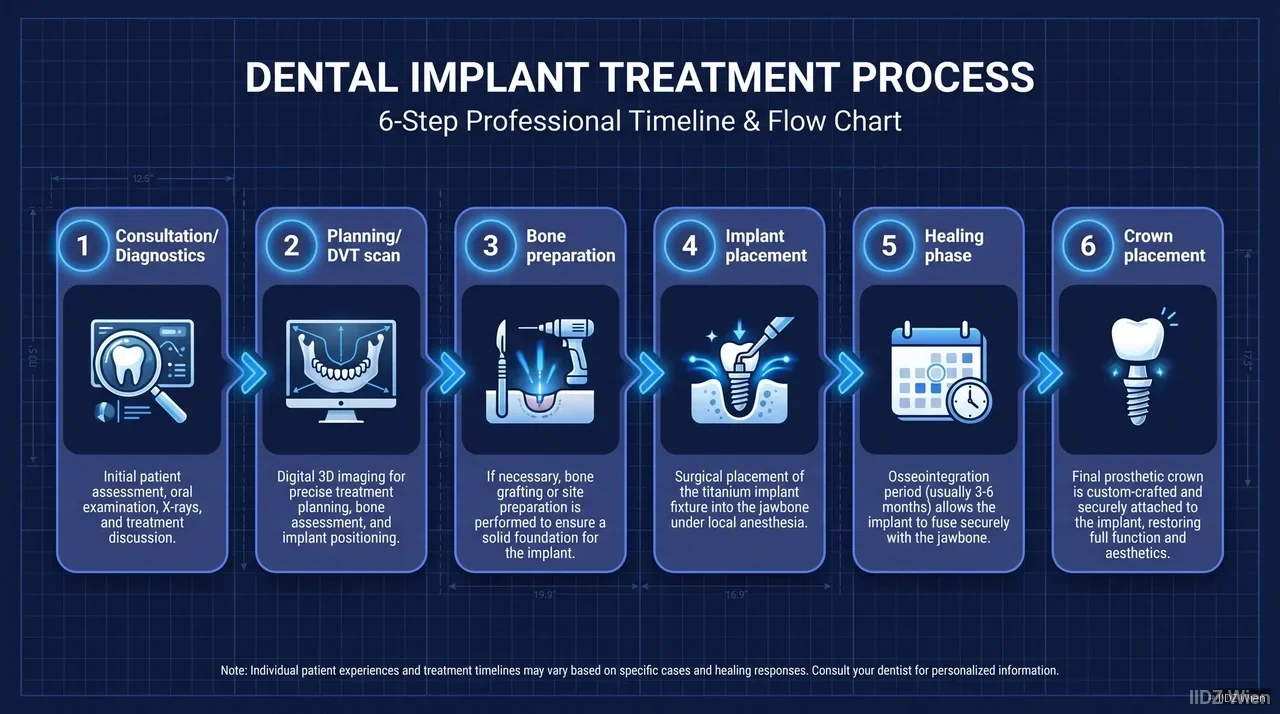
Dental implant treatment procedure
From initial examination to finished crown: 3–6 months (without bone augmentation).
Initial consultation & diagnostics
1 appointmentMedical history, clinical examination, CBCT (3D X-ray), cost estimate. Discussion of all options.
Possible bone augmentation
3–9 months healingWith insufficient bone volume: grafting or sinus lift. Healing before implant insertion.
Implant insertion
30–90 minutesOutpatient procedure under local anesthesia. Placement of titanium body into jawbone.
Healing phase
2–6 monthsOsseointegration: bone fuses with titanium. Temporary restoration possible.
Exposure & abutment placement
1–2 appointmentsImplant exposure, abutment (connector) placement, impression taking for crown.
Crown insertion
1 appointmentFinal crown of zirconia or ceramic is placed. Occlusion check.
Risks & Safety
Known risks (scientifically documented)
- • Implant failure (non-osseointegration): 2–5% in first 5 years
- • Peri-implantitis (inflammation): 10–20% of implants after 10 years
- • Nerve damage (rare, usually temporary): < 1%
- • Maxillary sinus perforation in upper jaw: 0.5–2%
Risk reduction through quality features
- CBCT diagnostics before insertion (3D bone assessment)
- Guided implantology with drilling template
- Established implant brands (Straumann, Nobel Biocare, Dentsply Sirona)
- Structured follow-up with regular professional cleaning
Possible alternatives to implants
An implant is not always the only or best option:
| Method | Suitable for |
|---|---|
| Dental bridge | If neighboring teeth are already damaged or have crowns |
| Removable partial denture | Interim restoration or if implants not medically possible |
| No restoration | Only in exceptional cases (e.g., last molar without opposing tooth) |
Follow-up care and long-term prognosis
With good care, implants last 20–30 years or longer. Follow-up care is crucial — not just the insertion.
Daily oral hygiene: toothbrush, interdental brushes, possibly water flosser
Professional cleaning (PZR) every 3–6 months in first 2 years
Annual X-ray examination to assess bone level
No excessive stress (grinding → night guard recommended)
Quit or significantly reduce smoking
Contact dentist immediately for gum bleeding, looseness, or pressure sensation
Long-term data (evidence)
95–98%
Survival rate after 10 years
20–30 y.
Average lifespan
>40 y.
Clinical experience with titanium
Prozess im Überblick
Schritt für Schritt — visuell erklärt
Checklist: What should be clarified in advance?
Tap an item to check it off.
Häufige Fragen (FAQ)
All prices stated on this page are average market reference values for the Austrian market (as of 2025). These are expressly not fixed prices of the Institute or any specific practice. Actual costs may vary significantly depending on clinical findings, scope of treatment, chosen material, and the individual practice. Binding cost information is available exclusively through a personalised treatment cost estimate (Heilkostenplan) from your treating dentist.
Further Guides
Clinical Partner
Consultation at Smile4Life
For a clinical assessment of your individual situation — in Vienna, 1010.
Medical note: The information on this page is for general educational purposes only and does not replace individual medical advice from a licensed dentist or specialist. The Institute for Implantology and Digital Dentistry Vienna is a non-profit, independent scientific platform — not a treatment facility. All content reflects current scientific literature; individual treatment decisions must always be made in consultation with a qualified dental professional.