Immediate implant – who is suitable?
An immediate implant sounds tempting: tooth out, implant in — all in one session. But this method is not suitable for everyone. This guide explains when an immediate implant makes medical sense, when it does not — and what alternatives are available.
Contents of this guide
What is an immediate implant?
An immediate implant (also: immediat implant) is placed immediately after tooth extraction into the still-fresh extraction socket — in the same appointment. This distinguishes it from the conventional approach, where after extraction you wait 3–6 months for the bone to heal completely.
Important distinction
Immediate implant
Implant is placed on the day of extraction. Bone not yet healed.
Immediate restoration
Implant already integrated, provisional crown is placed immediately. Two separate procedures.
The method is technically demanding and places high demands on the surgeon and the patient. The key factor is the so-called primary stability: the implant must be firmly anchored in the bone immediately — with a torque of at least 35 Ncm.
Who is an immediate implant suitable for?
The decision depends on several factors. Here are the most important indications and contraindications:
Fresh extraction without infection
The tooth is removed and the implant is immediately placed into the extraction socket. Requirement: no active inflammation, sufficient bone.
Adequate bone quality and quantity
Minimum 3–4 mm of bone below the socket for primary stability. Bone density D1–D3 (not D4 = very soft).
Good oral hygiene and healthy gums
No active periodontitis. Professional teeth cleaning before the procedure is mandatory.
Non-smoker or smoker with compliance
Smokers have a 2–3× higher risk of implant loss. At least 2 weeks smoking cessation before and 4 weeks after the procedure.
Active infection or abscess
In case of acute infection, healing must occur first. Immediate implant in infected tissue is contraindicated.
Severe systemic diseases
Uncontrolled diabetes, bisphosphonate therapy, immunosuppression — all significantly increase the risk.
Insufficient bone
If there is not enough bone after extraction for primary stability (>35 Ncm), an immediate implant is not possible.
What patients should fundamentally know
Primary stability is decisive
The implant must sit firmly in the bone immediately — at least 35 Ncm insertion torque. Without this primary stability, immediate implant placement is not possible. The surgeon measures this during the procedure.
Osseointegration takes equally long
Even with immediate implants, the bone needs 3–6 months to integrate. The time advantage comes from the fact that extraction and implantation occur simultaneously — not because healing is faster.
Provisional crown ≠ full loading
A provisional crown on the same day is aesthetic and functional — but it cannot be fully loaded. Hard foods and heavy chewing should be avoided during the first 6–8 weeks.
Benefits & Opportunities
Fewer procedures
Extraction and implantation in one appointment — instead of two separate surgeries with waiting time in between.
Shorter overall treatment time
3–6 months instead of 6–12 months with conventional approach. Provisional crown often possible on the same day.
Bone preservation
Immediate loading reduces bone loss by up to 40%. The socket remains better preserved.
Gingival contour remains stable
Papillae and gingival margin are better preserved when the implant is placed immediately — aesthetically important in the anterior region.
Psychological benefit
No tooth gap after extraction. Provisional crown on the same day provides security and quality of life.
Less bone augmentation needed
By preserving the socket, separate bone augmentation is often not required.
Limitations & Risks
Immediate implants are technically more demanding than conventional implants. The success rate is high — but only with proper patient selection.
| Risk | Frequency | Measure |
|---|---|---|
| Implant loss | 2–6% | Strict patient selection, primary stability >35 Ncm |
| Infection / peri-implantitis | 3–8% | Antibiotic coverage, strict oral hygiene |
| Bone resorption around implant | 5–12% | Correct implant position, connective tissue graft |
| Provisional crown unstable | rare | No chewing load in first 6–8 weeks |
| Aesthetic result suboptimal | 5–10% | Experienced surgeon, CBCT planning, anterior region critical |
The success rate of immediate implants is 94–98 % — but only with careful patient selection. With inappropriate indication, the risk of implant loss increases significantly.
What should be clarified beforehand
Before an immediate implant can be planned, the following points must be clarified by your dentist:
CBCT / 3D imaging
Without CBCT, no surgeon can seriously assess whether primary stability is achievable. Bone height, width, and density must be measured precisely.
Infection status
Active infection or abscess is an absolute contraindication. The area must be free of inflammation.
Periodontal status
Active periodontitis must be completely treated before the procedure. Professional tooth cleaning is mandatory.
General medical assessment
Diabetes, bisphosphonate therapy, immunosuppression, bleeding disorders — all of this significantly affects suitability.
Smoking status and compliance
Smokers must consistently quit at least 2 weeks before and 4 weeks after the procedure. Without this compliance, an immediate implant is not recommended.
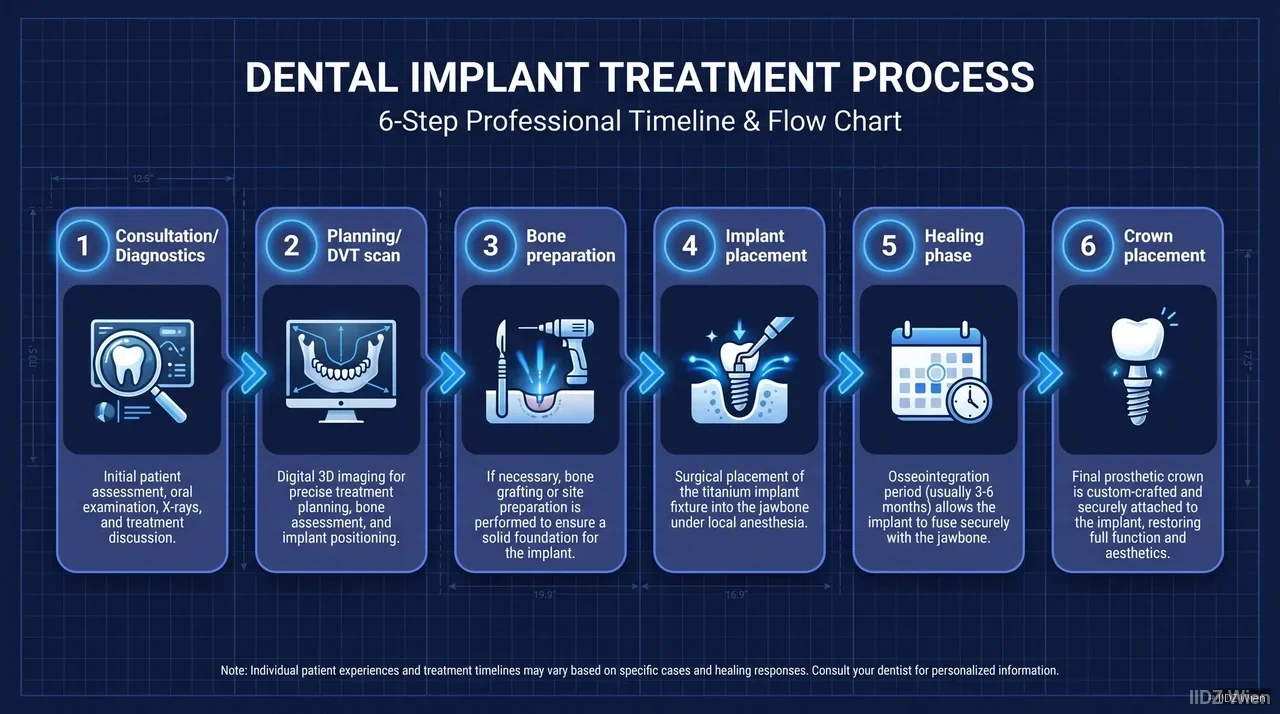
Typical procedure
CBCT / 3D analysis
Precise measurement of bone height, width and density. Assessment of whether primary stability is achievable.
Planning & informed consent
Digital implant planning. Detailed discussion of risks, alternatives and aftercare.
Extraction & immediate implantation
Atraumatic extraction, socket cleaning, immediate implantation. Duration: 45–90 minutes.
Provisional crown
If primary stability is sufficient (>35 Ncm): provisional crown on the same day. No full chewing load.
Osseointegration (3–6 months)
Bone grows into the implant. Check-ups every 4–6 weeks. No hard foods.
Final crown
After complete osseointegration: definitive impressions, laboratory fabrication, final crown placement.
Alternatives to immediate implants
| Option | Advantage | Disadvantage | Recommendation |
|---|---|---|---|
| Conventional implant | Higher success rate (97–99%), more planning time | Longer treatment time (6–12 months), tooth gap during healing | Gold standard when uncertain |
| Immediate restoration (not immediate implant) | Crown on the same day, but implant placed after healing | Two procedures needed | Good compromise |
| Bridge on adjacent teeth | No surgical intervention | Reduction of healthy teeth, no bone preservation | Only if implant not possible |
| Wait / bone augmentation first | Better starting situation for implant | Longest treatment time (12–18 months) | If contraindication for immediate implant |
Checklist: What should be clarified in advance?
Tap an item to check it off.
All prices stated on this page are average market reference values for the Austrian market (as of 2025). These are expressly not fixed prices of the Institute or any specific practice. Actual costs may vary significantly depending on clinical findings, scope of treatment, chosen material, and the individual practice. Binding cost information is available exclusively through a personalised treatment cost estimate (Heilkostenplan) from your treating dentist.
Clinical Partner
Consultation at Smile4Life
For a clinical assessment of your individual situation — in Vienna, 1010.
Medical note: The information on this page is for general educational purposes only and does not replace individual medical advice from a licensed dentist or specialist. The Institute for Implantology and Digital Dentistry Vienna is a non-profit, independent scientific platform — not a treatment facility. All content reflects current scientific literature; individual treatment decisions must always be made in consultation with a qualified dental professional.