Bone Augmentation – When is it Necessary?
Many patients learn during their initial consultation that their bone is insufficient for an implant. This guide explains when bone augmentation is necessary, what methods are available, what they cost, and how long healing takes.
Contents of this guide
What is Bone Augmentation?
A dental implant requires adequate bone to sit stably. As a rule of thumb: at least 6 mm bone width and 8–10 mm bone height. If this volume is missing, it must be built up before or simultaneously with implant placement.
Bone augmentation (bone augmentation) is a surgical procedure in which missing bone volume is replaced using autogenous bone, animal bone mineral, or synthetic materials. The bone integrates within months and thus creates the foundation for a stable implant.
Important: Bone augmentation is a prerequisite, not a complication. It is an established, well-documented procedure with high success rates — and in many cases, the only way to anchor an implant stably long-term.
Who is Bone Augmentation Relevant For?
Bone augmentation is necessary if the CBCT (3D X-ray) shows one of the following findings:
Bone Too Thin or Too Short
Implant diameter requires minimum 6 mm bone width, length minimum 8–10 mm
Tooth Loss Long Ago
After tooth loss, bone resorbs annually by 0.5–1 mm — after years, the foundation is often insufficient
History of Periodontitis
Inflammation-related bone destruction frequently leaves insufficient bone mass
Sinus Floor Proximity in Upper Jaw
In the upper posterior region, the sinus floor often lies too low for standard implants
What patients should fundamentally know
Bone resorbs after tooth loss
Without a tooth root, the jawbone loses its stimulus for bone maintenance. Per year, 0.5–1 mm of bone height is lost. After 5 years, this can amount to 3–5 mm — often too little for a standard implant.
DVT is the foundation of every plan
Without a 3D scan (DVT/CBCT), no surgeon can seriously assess whether and what bone augmentation is needed. If someone tells you without DVT that you don't need augmentation, they are not following current standards.
Materials: three options
Autologous bone (own bone, gold standard), xenogeneic material (bovine bone mineral, proven, no second surgery), alloplastic (synthetic, well tolerated). The choice depends on defect size and situation.
Smoking is the greatest risk factor
Smokers have 2–3× higher complication rates. Do not smoke for at least 2 weeks before and 4 weeks after the procedure — ideally stop permanently.
Benefits & Opportunities
Implants Become Possible
Without sufficient bone, no implant can be stable — bone augmentation creates the prerequisite
Long-Term Stability
Well-augmented bone keeps the implant stable for decades — success rate after 10 years >95%
Aesthetic Result
Adequate bone enables ideal implant position and natural-looking gum tissue
Preservation of Facial Structure
Bone augmentation prevents further bone resorption and maintains facial profile long-term
Predictability
Digital 3D planning (CBCT) allows precise prediction of the result before the procedure
Combinable with Immediate Implant
In certain cases, bone augmentation and implant placement can occur in a single session
What should be clarified beforehand
Before a bone augmentation can be planned, the following points must be clarified by your treatment provider:
DVT / 3D scan
Without DVT (Digital Volume Tomography), no surgeon can seriously assess whether and what bone augmentation is needed. This is the first and non-negotiable step.
General medical evaluation
Certain conditions (diabetes, osteoporosis, bisphosphonate therapy) affect healing. Your treatment provider must know your complete medication list.
Smoking status
Smoking is the greatest preventable risk factor. Do not smoke for at least 2 weeks before and 4 weeks after the procedure.
Periodontal status
Active periodontitis must be treated before any bone augmentation. Professional teeth cleaning is mandatory.
Time planning
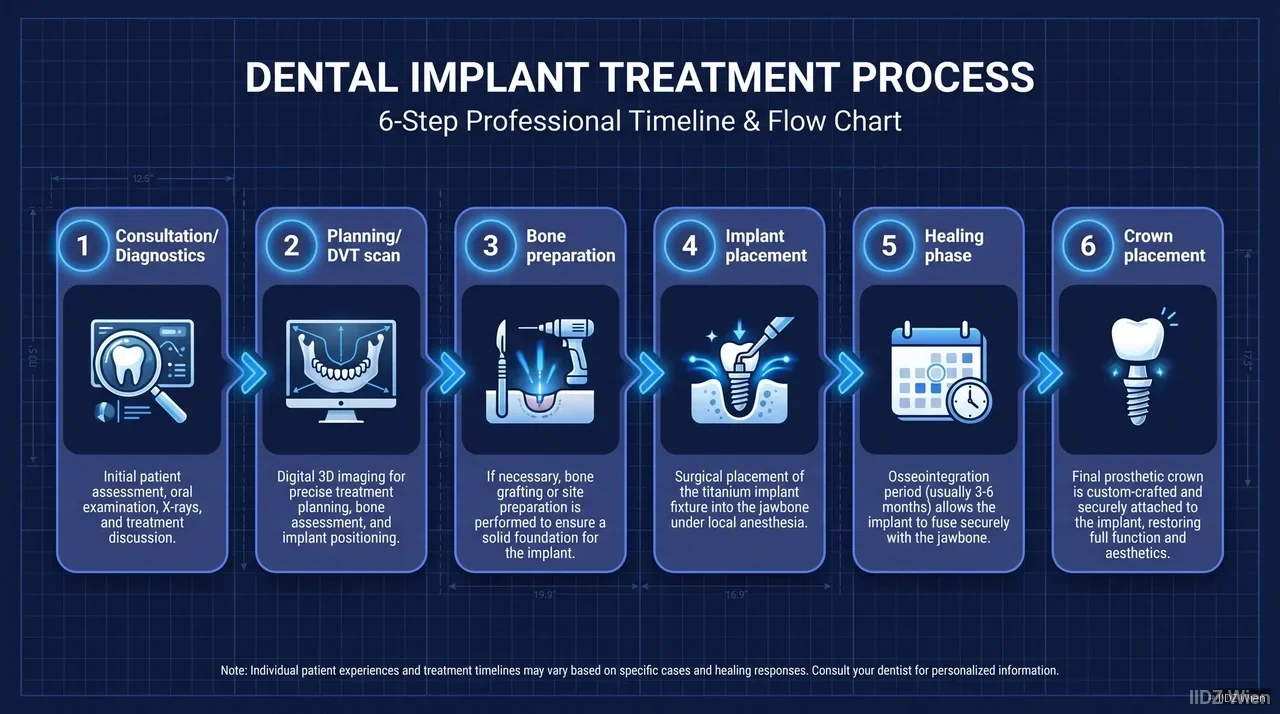
Bone augmentation extends the total treatment period by 4–6 months. This time must fit into your personal schedule.
Methods at a glance
Which method is used depends on the location, extent of the defect, and bone quality. The decision is made by the surgeon after DVT analysis.
Typical procedure
CBCT / 3D Analysis
Precise measurement of existing bone volume, sinus floor position, and nerve canal location. Foundation of all planning.
Method Selection & Consultation
Based on CBCT findings, the appropriate method is selected. Detailed consultation on procedure, risks, and healing time.
Procedure (Outpatient)
Bone augmentation under local anesthesia or sedation. Duration: 30–90 minutes depending on method.
Healing Phase
3–9 months depending on method. Bone integrates — checks at 2 weeks, 3 months, 6 months.
Control CBCT
3D imaging verifies bone volume and quality before implant placement. Critical for timing.
Implant Placement
Once sufficient bone is present, the implant is placed. Osseointegration takes another 3–6 months.
Risks & Limitations
Bone augmentation is a safe procedure, but like any surgery, it carries risks. The following complications can occur:
| Complication | Frequency | Action |
|---|---|---|
| Infection | 2–5% | Prophylactic antibiotics, strict oral hygiene |
| Membrane Exposure (GBR) | 5–15% | Close monitoring, possible membrane removal |
| Sinus Perforation | 1–3% | Immediate closure, rarely causes complications |
| Graft Failure | 3–8% | Repetition possible after healing |
| Nerve Contact (Lower Jaw) | < 1% | CBCT planning significantly minimizes risk |
| Extended Overall Treatment | always | Plan for +6–12 months total duration |
Alternatives to bone augmentation
In certain situations, there are alternatives that do not require bone augmentation. Whether they are suitable for you depends on your exact bone situation.
| Option | Suitable for | Advantage | Disadvantage |
|---|---|---|---|
| Short Implants (< 8 mm) | Bone 5–7 mm height | No augmentation needed | Lower primary stability, fewer long-term data |
| Narrow Implants (< 3.5 mm) | Bone < 5 mm width | No augmentation needed | Only for anterior teeth, higher fracture risk |
| Bridge on Adjacent Teeth | Healthy adjacent teeth present | No surgical intervention | Grinding healthy teeth, no bone preservation |
| Removable Denture | Multiple missing teeth | No surgery | No bone preservation, limited comfort |
Costs & health insurance in Austria
Typical costs (Vienna)
Health insurance Austria
ÖGK / BVAEB / SVS: Bone augmentation as part of implant treatment is not covered (implants = private dental treatment).
Private supplementary insurance: Depending on the plan, 30–80% cost coverage is possible. Check your contract before starting treatment.
Always request a written cost estimate (cost plan) before the procedure.
Checklist: What should be clarified in advance?
Tap an item to check it off.
All prices stated on this page are average market reference values for the Austrian market (as of 2025). These are expressly not fixed prices of the Institute or any specific practice. Actual costs may vary significantly depending on clinical findings, scope of treatment, chosen material, and the individual practice. Binding cost information is available exclusively through a personalised treatment cost estimate (Heilkostenplan) from your treating dentist.
Clinical Partner
Consultation at Smile4Life
For a clinical assessment of your individual situation — in Vienna, 1010.
Medical note: The information on this page is for general educational purposes only and does not replace individual medical advice from a licensed dentist or specialist. The Institute for Implantology and Digital Dentistry Vienna is a non-profit, independent scientific platform — not a treatment facility. All content reflects current scientific literature; individual treatment decisions must always be made in consultation with a qualified dental professional.